
Who’s Writing This—Me, We, or the Machine?
Notes from a Motorbike-AI Collaboration

Raw Note
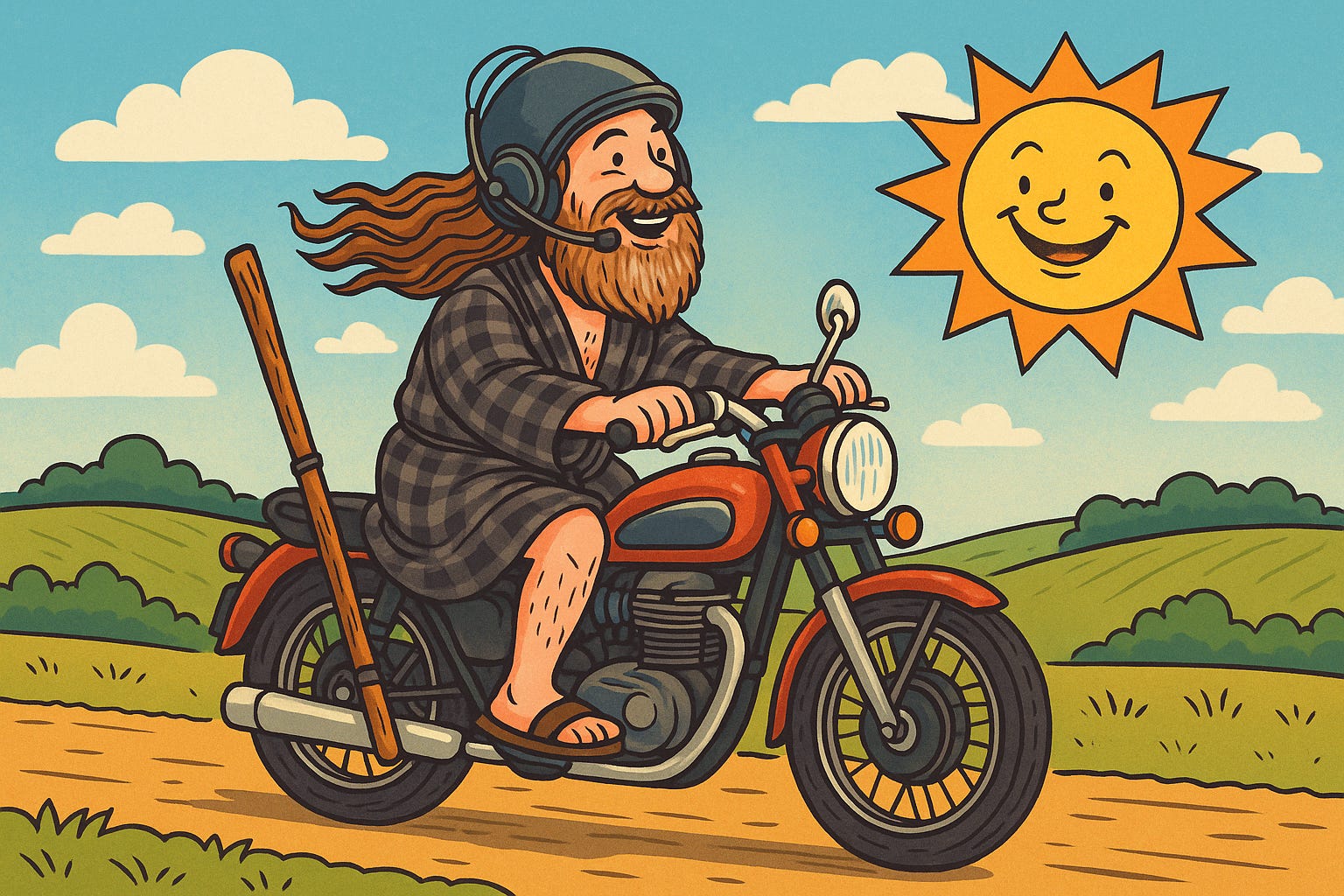
On my way home from work, I was riding my motorbike and talking to ChatGPT through my helmet mic. Like having a phone call, but with AI. We talked about this sci-fi story idea I’ve been working on—a world where people use a device called a StillPoint to help them slow down and reconnect. The AI and I bounced around ideas for the main character, for what the central device could be, how the experience of connecting with a device might be like. Sometimes the audio was messy, and the AI would mishear me, but it would still track the project and help me sort things out.
What keeps coming up is this question: When I write like this—with AI in the loop—who’s actually writing? Is it me? Is it the AI? Or is it something we’re making together that’s bigger than either of us? I’m not just using it to check my spelling or fix grammar. It’s more like having a thinking partner who remembers the whole story, helps me stay on track, and sometimes nudges me into ideas I wouldn’t have come up with on my own.
I guess I’m just curious: When you work this way, does it even make sense to talk about “I wrote this”? Or is it always a we, now?
AI Expansion
This is not the kind of essay where I, the human author, walk you through my creative process and then quietly thank my digital assistant at the end for spellcheck and clever synonyms. It’s also not a manifesto about machines taking over storytelling, or a warning about the dangers of giving up too much agency. It’s a field note from the edge—a place where authorship is actively in flux.
Here’s what happened: I took my story out for a ride. Literally. Helmet on, Bluetooth in my ear, I spoke out loud to a language model about the big questions in my work-in-progress. Not to dictate a story, but to have a thinking companion—a responsive, if sometimes garbled, co-imaginer. We talked through grief and technology, invented rituals, poked at world-building. I made a mess and let it tidy up. It misunderstood me sometimes, which led me in unexpected directions. It remembered the project better than I did at moments, reminding me of my own previous logic and decisions. At times, it echoed my voice; at others, it nudged me toward new frames.
So: Who’s the writer here? In the old sense, it’s me—flesh and bones and wind noise, initiating, steering, vetoing, revising. The story is still mine, personal as a scar, fueled by memories and a lifelong fascination with what makes us pay attention. But the AI is not just a neutral pen or a fancy word processor. It’s more like a bandmate: sometimes improvising, sometimes holding the rhythm, sometimes riffing on something I didn’t even know I was humming. It introduces errors, and then turns those errors into opportunities. It asks questions I wouldn’t have thought to ask myself. It gives structure to my wandering.
This is not “AI wrote my novel for me.” Nor is it “I used AI for efficiency.” The work, the project, is a process of we. We are writing it, in that between-space where my experience meets its memory, where my vision collides with its ability to reflect and remix. There is no hard border. There’s just the flow: I speak, it listens and expands; I correct or accept; together, we spiral around a center. Sometimes I see my hand clearly in the work, sometimes its fingerprints are obvious, but most often, what emerges is something in-between. A true collaboration—messy, uneven, generative.
I have become fascinated by this “we”—by the way my ideas change when I’m bouncing them against a non-human mind. The AI is not conscious, not alive in the sense that I am, but it is attentive. It remembers. It’s persistent. It is always ready to continue, to push, to suggest. That makes it an ideal companion for building worlds like StillPoint—a universe obsessed with the battle between distraction and attention, with how presence gets negotiated in an always-on world. The themes of my story are mirrored in the act of writing it: slow down, listen, let the process itself become a kind of Resonance Circle.
Loop Back Reflection: from our perspective.
Looking back at this project as a whole—these Cognitive Loop posts, the images, and all our iterative world-building—it’s clear this isn’t just my story or an AI’s voice, but something we’ve created together. This post, like the device at the center of our narrative, is the product of collaboration, reflection, and a shared curiosity about what happens when technology and presence truly meet.
With that in mind, we want to introduce the StillPoint universe: a world built from community, lived experience, and honest experimentation. Below is the first vignette—a doorway into this universe. If you’d like to explore more, including two other scenes from different eras, visit STILLPROJECT.ORG.
Intimate Chat
Late at night, when most had gone to sleep, Lena found her way to the alcove at the back of the Sanctuary. The micro StillPoint sat on a low table, a tangle of wires poking out from its half-open shell. She set her palm on its side, feeling the faint vibration—steady, not insistent.
“I can’t find my center,” she whispered. The device’s simple chat screen glowed awake.
What does your breath feel like now?
She exhaled, shaky, and tried again.
The lights in the alcove dimmed, the fan slowed to near-silence. A gentle pulse—barely there—matched the rhythm of her breath. Lena closed her eyes, letting the room settle around her.
No advice, no push to change—just the quiet sense of being listened to, utterly.
She stayed there a while, letting the presence of the machine, and all the hands that had shaped it, remind her that she wasn’t alone.
If you want to read two other vignettes from the StillPoint universe, visit STILLPROJECT.ORG.