
The Third Road
Between surrender and refusal, there's a third way

Cognitive Loop is how I think out loud with AI: a raw note, a visible back-and-forth, edited until I can hear my own voice in it. AI as a bridge, not a buffer. I leave the seams showing on purpose — and in a piece about AI and writing, that feels like the only honest way to do it.
Raw Note:
I'm trying to formulate a response to that Jack video. I kind of think there's a divide between people who are technical and especially programmers and people that are like non-technical like even this Jack. All he sees is people use it to all they use it for is like summarizing their emails or like drafting and that is a concern and he is right to be concerned but technical people see what you can build with it, systems thinkers. See what you can. See the power in it. Where is that's the part that he's not like Powers the wrong word though right? Cuz it is a power. Maybe this is pyramid and tipi tention too
I even see it at work and the people who are engaged are the programmers cuz they think they can see. Well yeah crazy times
Jack's Video, and His Conclusion
Jack a content producer I respect (@watchfulcoyote) posted a TikTok called "What Roads Are You Driving, and do you know the risks?" It opens with backcountry terrain. In the woods, there are four layers of dirt road — a maintained public road, a private gravel road, an unimproved track, a raw snowmobile trail. On GPS they're all the same color. A local can read them at a glance. Someone from out of town can't. Jack watched a woman in a Buick end up four layers deep on a snowmobile trail, oil pan grinding, no idea where she'd gone wrong.
Then he uses GPS reliance as an example of what is happening with AI: "How deeply is AI part of your life now? ...summarizing your emails? tone edit your messages, plan meetings for you, write for you, take on your voice?" Each layer looks like the one above it. The risk compounds without you noticing. He cites cognition research on what outsourcing your thinking does to the brain over time. He goes to the frontier: "we do not know what the fuck we're doing right now... we are releasing this technology way faster than we know anything about how to control it."
His personal line is auto-generated captions — spell-check below it, nothing above. His conclusion: AI "has to be completely and totally dismantled" for humanity to survive.
Watch it if you haven't. He's a sharp thinker. And if his conclusion felt like relief — finally, a clean exit from all this AI chaos — I understand that. But I want to offer a different map.
He's Right About the Danger
The voice-flattening is real. I've watched it happen to people — watched someone's writing go from specific and alive to smooth, confident, and hollow. The output still looked like writing. The muscle atrophied while the product improved. They didn't notice until someone who knew their actual voice pointed it out.
I've caught it starting in myself — the pull toward letting the AI take the first pass on something I should be thinking through, the slight loosening of effort that feels like efficiency but is actually drift. So I've been building countermeasures, including this format: raw human note first, AI expansion visible and labeled, the back-and-forth kept honest. The trail Jack is describing is real. The worry is earned.
The question isn't whether the danger exists. It's whether "dismantle it completely" is the only response to it.
The Third Way
Jack's frame is all-or-nothing: either you let AI take your voice, or you cut it off entirely. But that's not actually the choice in front of you.
Think about the road metaphor he started with. The woman in the Buick didn't end up four layers deep on a snowmobile trail because dirt roads are inherently doomed. She got there because she was following a GPS that couldn't tell the roads apart — and she didn't have the knowledge to read the terrain herself. The road wasn't the problem. The missing skill was.
People go down snowmobile trails on purpose. Hunters. Backcountry skiers. Locals who know every fork. Not in a Buick — in a vehicle that's right for the terrain, with the equipment to handle what comes up, with the situational awareness to know exactly where they are. You have to do it in a 4x4 that's outfitted properly.
I came at AI from the technical side — my work is computer security, so when it arrived I felt obligated to understand how it actually worked, under the hood. That gave me confidence. But it turned out not to be the thing that keeps you safe on the trail. The road I'm pointing you toward isn't the one I took.
With AI, that equipment is not programmer skills. It's not technical knowledge. It's the human skills you already have or can build: critical thinking that stays engaged instead of going passive, enough self-awareness to notice when you're drifting off the trail you choose, a commitment to keeping your voice yours. That's it. None of that requires a computer science degree. It requires paying attention — the same thing you'd need to drive backcountry terrain safely.
You don't have to choose between driving blindly and never driving at all. You can learn to read the road.
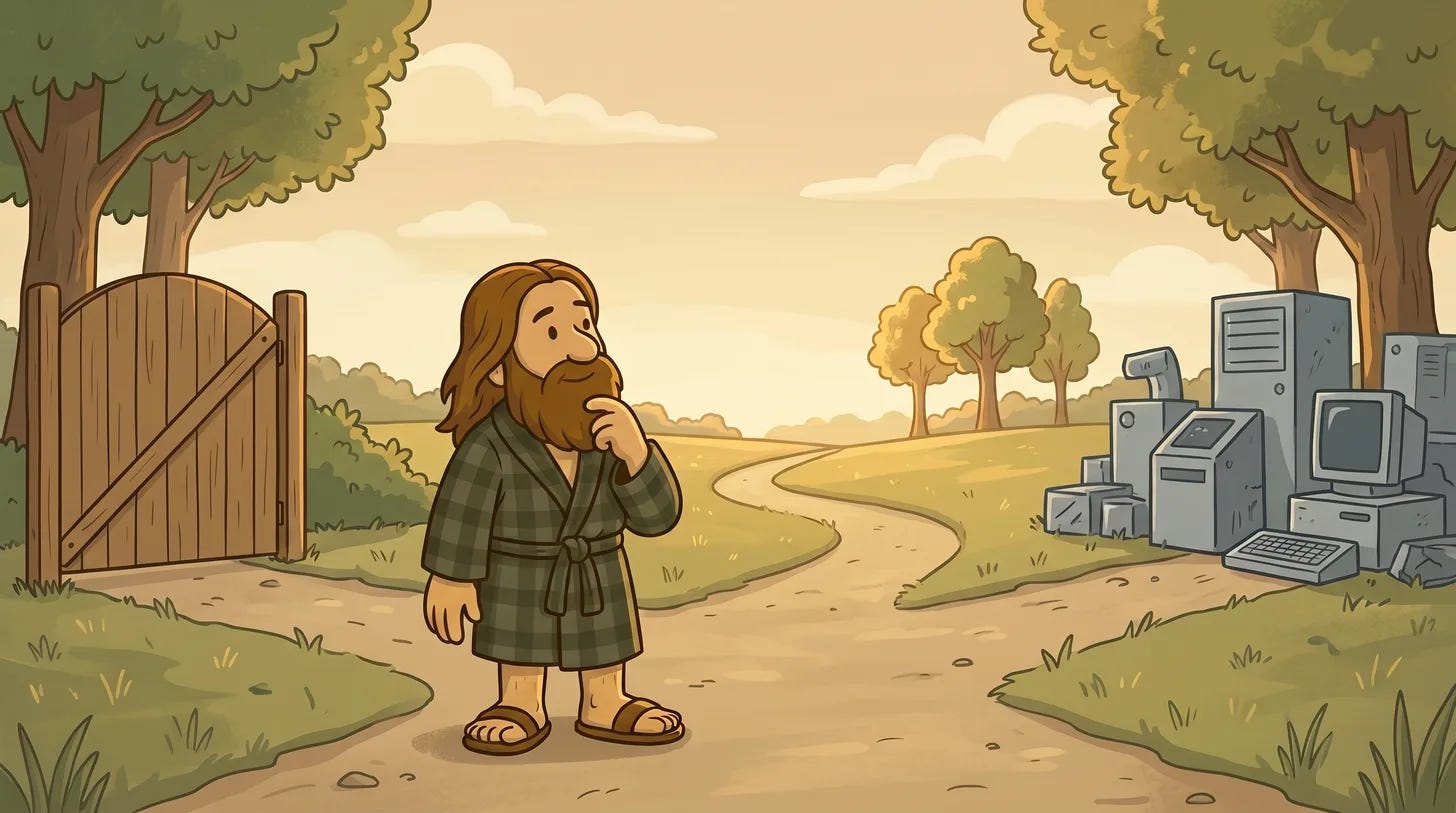
And some of what you can build with that preparation is genuinely worth building. Not pyramids — not the extractive, scale-everything, concentrate-power-at-the-top version Jack rightly warns about. Something more like a tipi: portable, communal, yours to take down and move. Tools that give you and the people around you more independence, not less. That road exists. It's just not on the GPS most people are following.
Loop Back Reflection
I talked into my phone — raw, half-formed, wrestling with something I hadn't resolved. Bob, the AI I think with, found the argument in the mess and built it out. Then I pushed back where it was wrong, cut what got too clever, rewrote until I could hear myself. The seams stay showing on purpose.
Raw human note, visible AI expansion, the dialogue kept honest and in the light. That's not ghost-writing. It's not autopilot. It's the third way in practice — small, specific, and transparent about what it is.
Jack might still call this the snowmobile trail. He might be right that some people doing something like this are deeper in the woods than they know. I take that seriously — it's why the countermeasures are built into the format itself.
But this is what driving prepared looks like, from inside the vehicle.
Wally's original prompt, preserved:
I'm trying to formulate a response to that Jack video. I kind of think there's a divide between people who are technical and especially programmers and people that are like non-technical like even this jacket. He's you know people use it to all they use it for is like summarizing their emails or like drafting and that is a concern and he is right to be concerned but technical people see what you can build with it systems thinkers. See what you can. See the power in it. Where is that's the part that he's not like Powers the wrong word though right? Cuz it is a power. Maybe this is pyramid and teepee tention too
I even see it at work and the people who are engaged are the programmers cuz they think they can see. Well yeah crazy times