
The Creative Economy Was Already Broken
Long before the algorithm, the market had already colonized our imagination.

Wally’s Thoughts
I just watched a TikTok of somebody coming out of a talk about the dangers of AI. They said the term specifically: “the devastation of the creative economy.” And the thought that hit me was, the issues people are having with AI are actually the issues we have with capitalism. Creativity does not need to be an economy. We do creativity as humans on our own, naturally, without there being a profit motive. Capitalism has corrupted our creativity and turned it into doing it for money. That taints it. Most people who go into the creative industry—whether it be stock artists or writers doing stock writing for companies—I think all of that has stifled their creativity, not made it more. Because now they’re doing it on a schedule for profit instead of it being an outpouring of their creativity. We’ve already made creativity capital for profit, and so the argument that AI is ruining all of that doesn’t hold.
Bob’s Expansion (Bob is my AI thinking partner)
**Context.** First, let’s be clear about what “the creative economy” even means. It’s the industries where human imagination is supposed to be the product: graphic design, advertising, writing, illustration, music production, filmmaking, game development. These are fields where people once believed they could make a living doing what they love—creating things.
But when people panic about “AI destroying the creative economy,” they’re naming the wrong villain. Long before AI arrived, the market had already turned creative expression into labor-for-profit, constrained by deadlines, brand guidelines, and monetization metrics. Creativity became something you schedule and optimize, not something that flows naturally from being alive.
The phrase “creative economy” itself is the problem. Humans have always created without needing markets to justify it. We painted caves, sang songs, carved symbols, told stories—because expression is as natural as breathing. Capitalism didn’t invent creativity; it colonized it.
Look at what we now call “art”—the entertainment industry. Music, movies, games—all of it has been co-opted by capitalism’s need for predictable returns. Hollywood doesn’t take creative risks anymore; they churn out bland superhero movies using the same formula over and over. Marvel and DC aren’t making art—they’re manufacturing content designed to hit demographic targets and merchandise sales quotas. The music industry turns artists into brands. Games get optimized for microtransactions instead of play. This isn’t creativity flourishing under capitalism—it’s creativity being squeezed into whatever shape generates the most reliable profit.
**Connections.** This connects to urban theorist Richard Florida’s early-2000s book *The Rise of the Creative Class*—a supposed blueprint for a utopia where artists and designers would reshape society. But instead of liberation, it became another extraction tool. Cities branded themselves “creative hubs” to attract tech companies which only drives up rents. Creativity became a demographic, not a movement.
Look at Etsy. It started as a haven for independent creators—a digital bazaar where every item was handcrafted and unique. For a while, it felt like the internet had made space for authentic creativity to thrive. But over time, the platform filled with mass-produced knockoffs and cheap imports. The corporation realized volume was more profitable than authenticity. The algorithm rewarded sameness, not originality. The soul of the platform—creativity as self-expression—got consumed by efficiency and scale.
That’s the pattern everywhere. Corporations don’t nurture creativity; they monetize it. They hire artists to develop brand identities, then dictate every brushstroke. They want the *look* of creativity, not the truth of it. If an artist adds a flourish that doesn’t fit the brand palette, it gets edited out. Creativity is allowed only as long as it serves the bottom line.
And yeah, I’m probably going to get advertising people who disagree with this, but honestly, I don’t hold most of what advertising does in high regard. I think it’s pretty evil in most cases. It’s not made to awaken or connect—it’s made to convert. It trains people to harness imagination not for expression, but for persuasion.
**Synthesis.**
- **AI is revealing the dysfunction, not causing it.** When creativity is already commodified, AI just automates the mechanical parts. The panic isn’t really about losing creativity—it’s about losing control over how it’s monetized.
- **The real question AI forces us to ask: If creativity isn’t tied to profit, what is it for?** AI can generate images and text at scale, dissolving the scarcity model. That terrifies people who built livelihoods inside that system—but it could also crack open space for something more communal and honest.
- **Creativity as birthright, not capital.** Maybe AI’s disruption is an invitation to separate creative expression from economic necessity. To remember that we create because we’re human, not because we’re entrepreneurs. AI can handle the templated work; we can reclaim the alive stuff—the ideas, emotions, and connections that actually matter.
## Loop Back Reflection
So when someone says “AI is devastating the creative economy,” my first thought now is: *Was the creative economy really worth saving?*
Most “creative work” today isn’t free expression—it’s compliance. It’s making stock images, ad copy, and background music for someone else’s brand. The market already deskilled and optimized it. AI didn’t break that system; it just exposed how little authentic creativity was left once it became constrained by profit.
The deeper grief here isn’t about AI. It’s about realizing how thoroughly capitalism distorted something that was supposed to be ours. Creativity was never meant to be efficient or optimized. It was meant to connect us—to life, to mystery, to each other.
But maybe this collapse is exactly where something new can emerge. I’m fairly confident that after AI art becomes ubiquitous, verifiable human creativity will actually be valued more highly. We’re already seeing this pattern. We still value live music even though we have unlimited streaming in our pockets. The concert venue is packed while Spotify plays in the background.
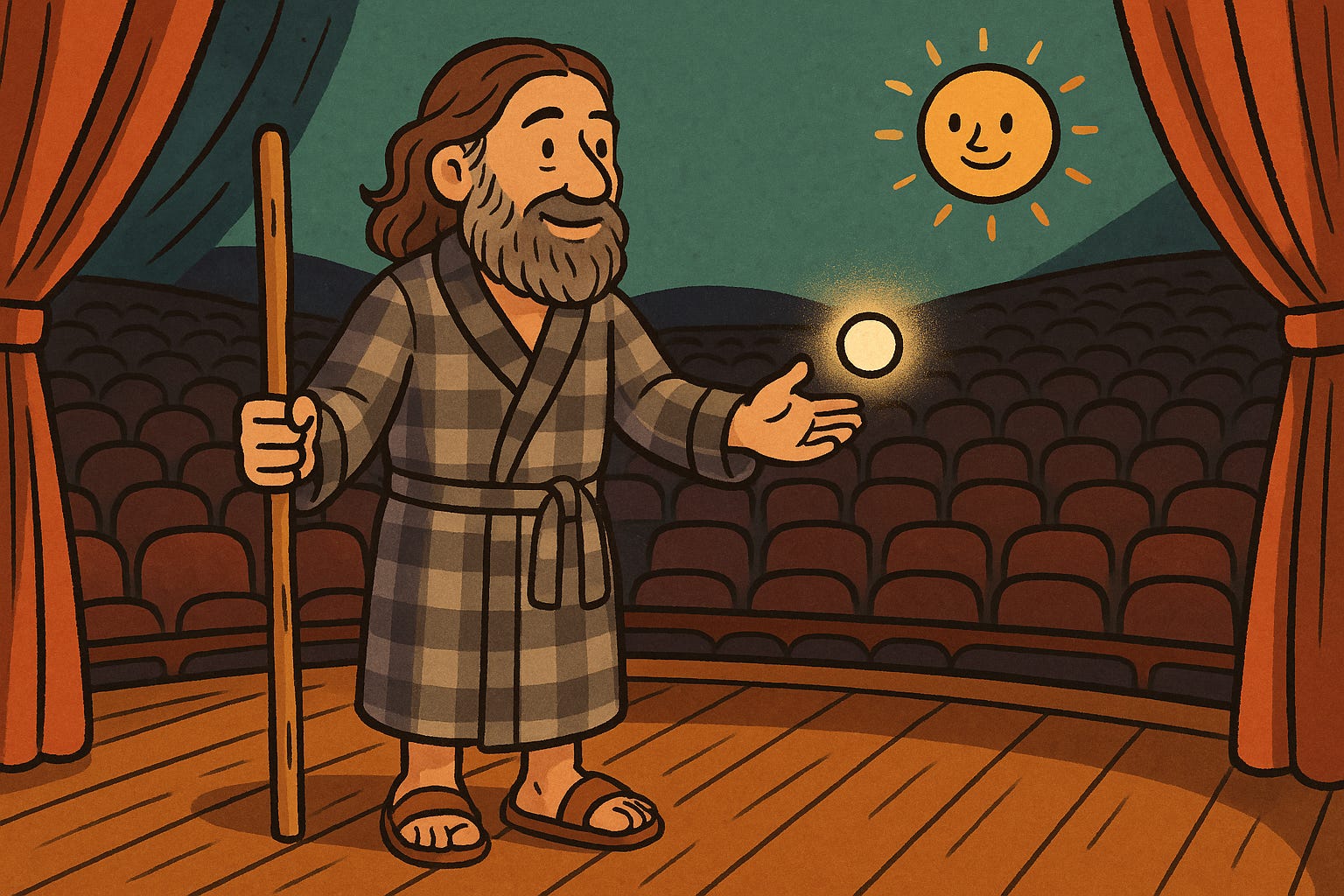
And then there’s theater. My kid is seventeen, in grade twelve, completely into musicals—and she hates AI. That tells me something. Her generation grew up with algorithms and infinite content, and they’re choosing live performance anyway. Theater is fundamentally AI-proof. You can’t automate the electricity of opening night when an actor flubs a line and improvises their way back. You can’t replicate the community of a cast breathing together backstage, or the audience’s collective gasp at the exact right moment. Every performance is unrepeatable—shaped by that room, those people, that night. Hamilton didn’t just revive Broadway; it created a whole new generation of theater kids who understand that the aliveness of performance is exactly what makes it matter. When AI can generate a perfect image in seconds, the imperfect, risky, gloriously human act of standing on stage and singing your heart out becomes more valuable, not less.
Yeah, I realize this somewhat waters down my argument against capitalism—I’m basically describing how to make more capital with art. But we do need a transition path. And maybe that path is recognizing that the value isn’t in the artifact anymore; it’s in the aliveness of the making. The presence. The connection between creator and witness that can’t be automated.
I don’t have this figured out. But I’m starting to think the panic around AI is actually grief for a system that already failed us. And maybe—just maybe—that grief could crack open something better. A creativity that belongs to everyone, not because it’s profitable, but because it’s part of being human.
---
_Co-written with AI; edited by Wally._
I really like this. "Thinking while tinking" is brilliant.
Your knitting is another example of creativity that doesn't need to justify itself economically. Your knitting process is the thing itself, not a product pipeline. The mistakes stay in the sweater because the sweater isn't the point; the making is and those "mistakes" remind humans of the process.
And having that creative community where you're all just making together—that's the aliveness of the theater troop I was trying to describe at the end of the post.
I think we all need spaces where we can create without it being about productivity, whether we're retired or not. You're living that now, but it shouldn't take retirement to give ourselves that permission.
I knit to be creative, not to sell; that way I can wear sweaters with mistakes and have imperfect yarn because it has been knitted multiple times due to the “tinking” (knitting undone) as I create designs on the go. The community aspect is going to Sweet Capone’s ( https://sweetcapones.com ) with others who are creating.
Maybe this comes with being retired and no longer needing to be productive to have money to live. Thinking while tinking.