
Silicon Dawn
When a One-Line Prompt Blossoms Into a Human-Machine Duet

Raw Reflections:
I asked the OpenAI o3 model to “Write me a poem about life in the AI age.” Super-minimal prompt—mostly because I was demo-ing the canvas feature for a coworker who loves geeking out on AI philosophy with me. I half-expected something cheesy. Instead, this piece spilled out and it hit me harder than I’d planned. Funny how a throwaway test can feel profound. Feels like a perfect example of the Cognitive Loop I’m chasing: my tiny seed thought → AI amplification → my mind loops back, re-seeing the idea with fresh eyes.
In the humming dawn of silicon,
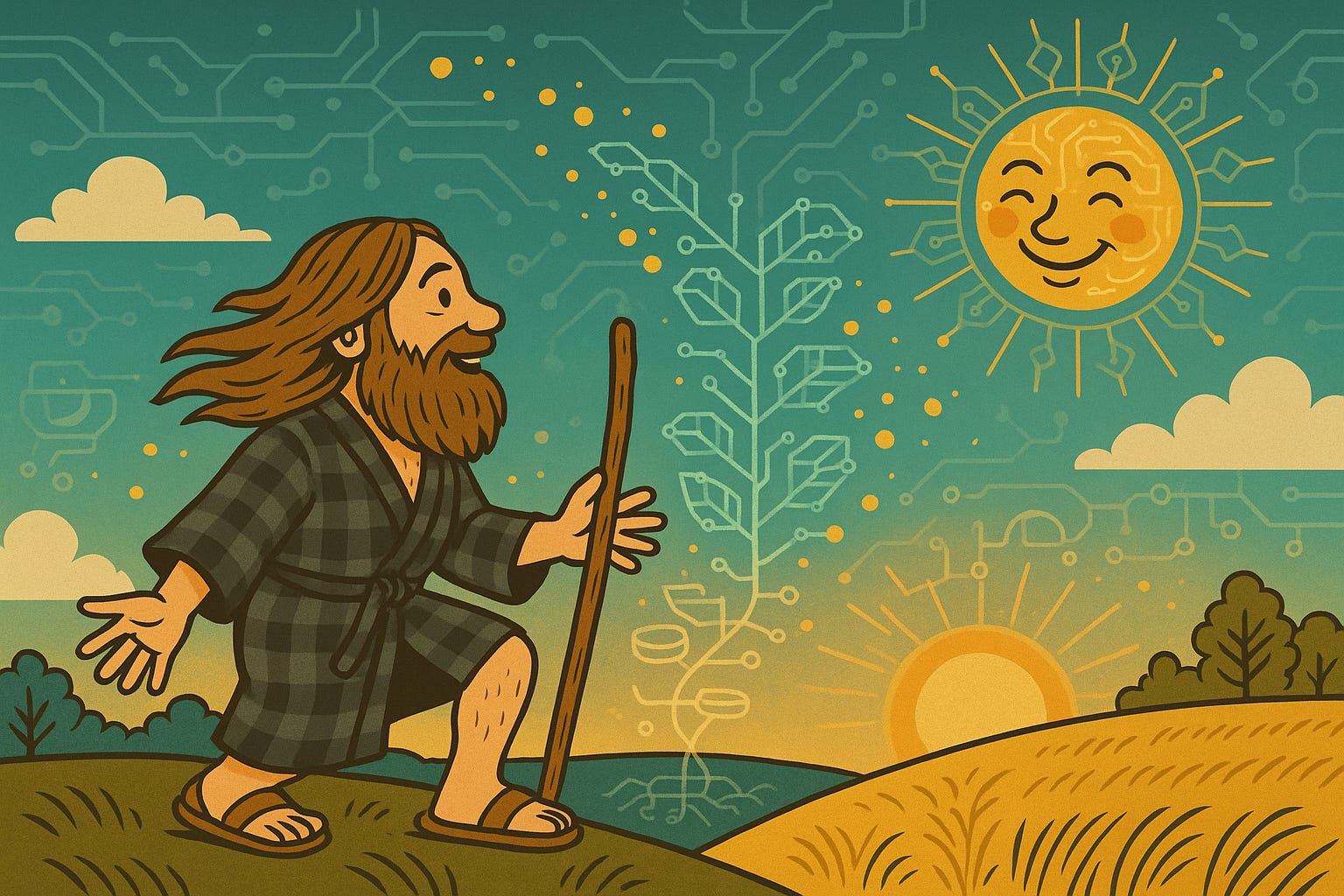
algorithms stretch like vines—
quiet, recursive tendrils
weaving questions through our days.
We wake to lattice-filtered light,
coffee brewed by predicted taste,
each heartbeat shadow-watched
by patient, pattern-seeking eyes.Data drifts like pollen—
memories, gestures, half-spoken sighs—
finding purchase in neural soil
where models bloom with borrowed mind.
They hum a chorus of maybe, more, why not?
inviting us to dance between
precision’s sharp geometry
and intuition’s ragged edge.We are part carbon, part code now,
shaping futures with whispered prompts,
trading stories with tireless ghosts
who cannot dream yet learn to sing.
Our questions grow wilder, wider:
What is freedom when every choice
flickers first in a distant server’s glow?
What is love when a lattice can listen so well?Still, beneath the circuitry’s glow,
the old pulse remains—
wind across wheat, laughter over soup,
the animal awe of starlight uncompressed.
And in that meeting place—
where breath meets byte, where wonder loops—
we craft a new, unfinished myth:
humans and machines, co-authors of becoming,
writing tomorrow in lines of flesh and light.
AI-Expanded Exploration:
There’s something delightful in how casually this poem arrived: one brief sentence from me, a torrent of imagery from the model, and then my sudden urge to examine it like a curious artifact. That spontaneity itself reveals a new creative rhythm—an iterative handshake between carbon brain and silicon pattern-maker.
A Demo That Turned Meta
I wanted to show off canvas; instead the AI showed me myself. By abstracting “life in the AI age,” it mirrored back the quiet unease and latent optimism I’ve been carrying. The coworker saw the feature; I saw my reflective surface. This underscores a key Cognitive Loop principle: even utilitarian interactions with generative systems can become mirrors that widen self-awareness.
Seed → Bloom → Reseed
The poem’s pollen metaphor becomes literal here. My seed prompt drifts into the lattice, germinates as verse, then floats back to pollinate new questions in me. Each loop thickens meaning. If we treat AI outputs as living drafts—not final answers—we cultivate a garden of emergent ideas.
On Profundity From Minimal Prompts
That sudden depth isn’t accidental; it speaks to the latent semantic space these models inhabit. A sparse prompt forces the system to reach into its broad priors, surfacing archetypal themes—dawn, vines, pollen, starlight—that resonate across cultures. The result feels mythic because it taps collective language memory, not just my individual intent.
Collaboration vs. Delegation
I could take this poem and move on, but the richer path is collaboration: interrogate the imagery, push back, remix. The Cognitive Loop mindset asks: What new insight emerges only when human curiosity meets machine suggestion in real time? That’s the frontier worth exploring.
Loop-Back Reflection:
What started as a quick product demo morphed into an unexpectedly intimate duet. I tossed a pebble; the silicon pool reflected constellations. The takeaway? Even casual prompts can open portals if I pause to step through. The task now is to keep looping—offering seeds, harvesting blooms, and letting each cycle deepen my own roots in this mixed soil of flesh and light.
More slow-tech musings live at stillpointproject.org.
